
SPX Credit Spread Planner: How to Size a Defined-Risk Spread Before You Sell It
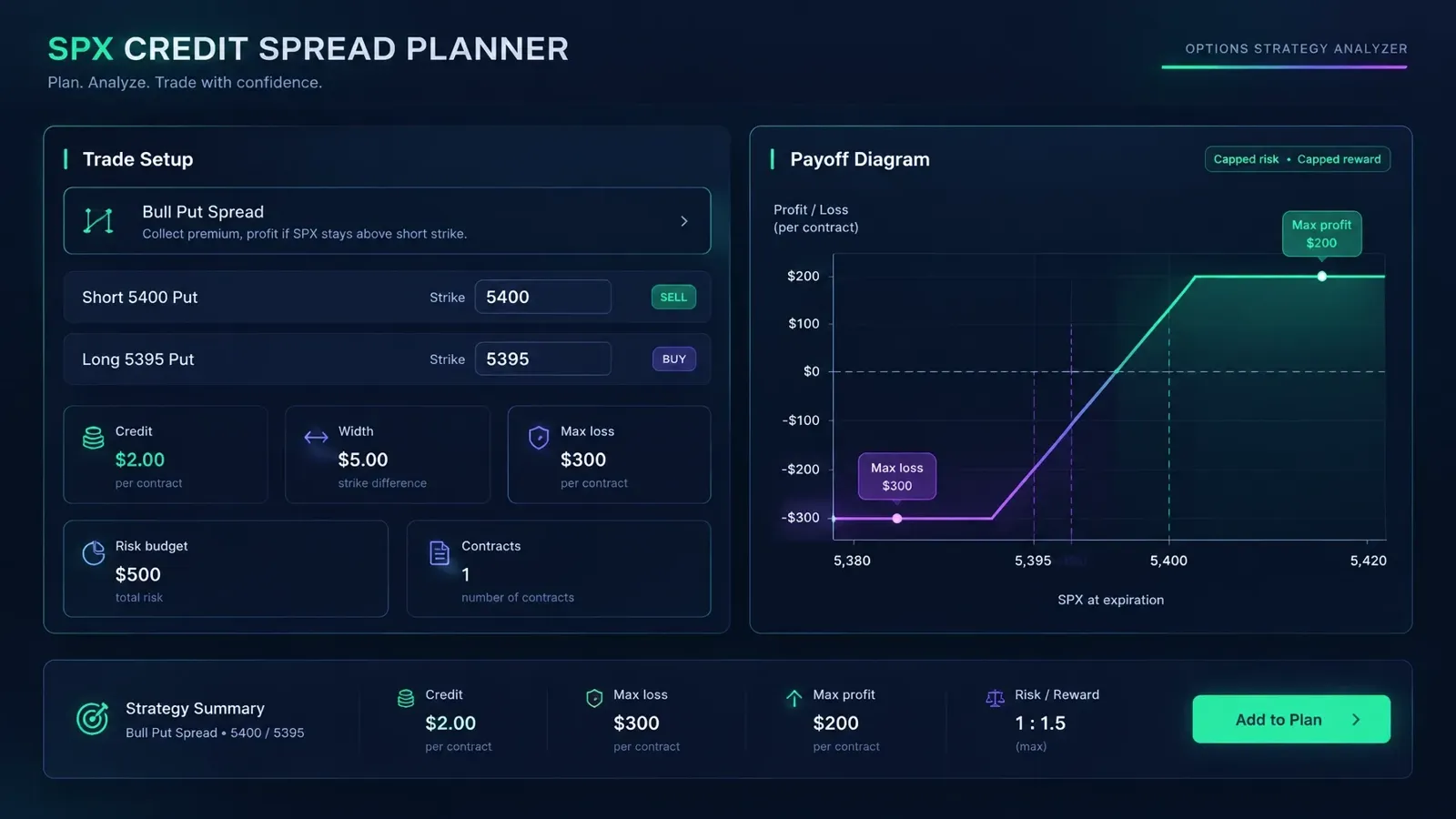
An SPX credit spread can have a clear maximum loss and still be too large for your account. The practical way to size one is to calculate the spread’s maximum loss per contract, set a dollar risk limit, and choose a contract count that stays within it.
This matters because the credit you collect is not the amount at risk. For a defined-risk credit spread, maximum loss depends on the distance between the strikes, the credit received, and SPX’s $100 multiplier. Your plan should account for all three before you place an order.
Account for SPX settlement mechanics
SPX options differ from equity options in a few important ways. They’re cash-settled and European-style, so they don’t deliver shares and can’t be exercised early. That removes the risk of early assignment, and the share-related pin risk that can come with equity options near expiration.
It does not remove expiration risk. The cash settlement value depends on the contract’s settlement terms, and some SPX expirations use a special opening quotation rather than the familiar closing index value. Standard third-Friday SPX options are generally AM-settled; many SPXW weekly and daily expirations are PM-settled. Check the exact contract and its settlement value before trading. Cboe’s SPX specifications and its guide to standard AM settlement explain these mechanics.
For a spread held through expiration, the settlement value determines the final payoff. It may not match the index level you saw at another point that day. Confirm whether your contract is AM- or PM-settled, and make your exit plan with that distinction in mind.
Calculate maximum loss before choosing contracts
For a vertical credit spread, use:
Maximum loss per spread = (spread width − credit received) × $100
The $100 multiplier converts each SPX index point into $100 per contract. Your risk budget then determines how many spreads fit:
Contracts = floor(maximum dollar risk ÷ maximum loss per spread)
Use the smaller of that calculation and any lower contract limit in your trading rules. The formula gives a risk-based ceiling, not a recommendation to use the full amount.
Worked example: $50,000 account and 1% risk
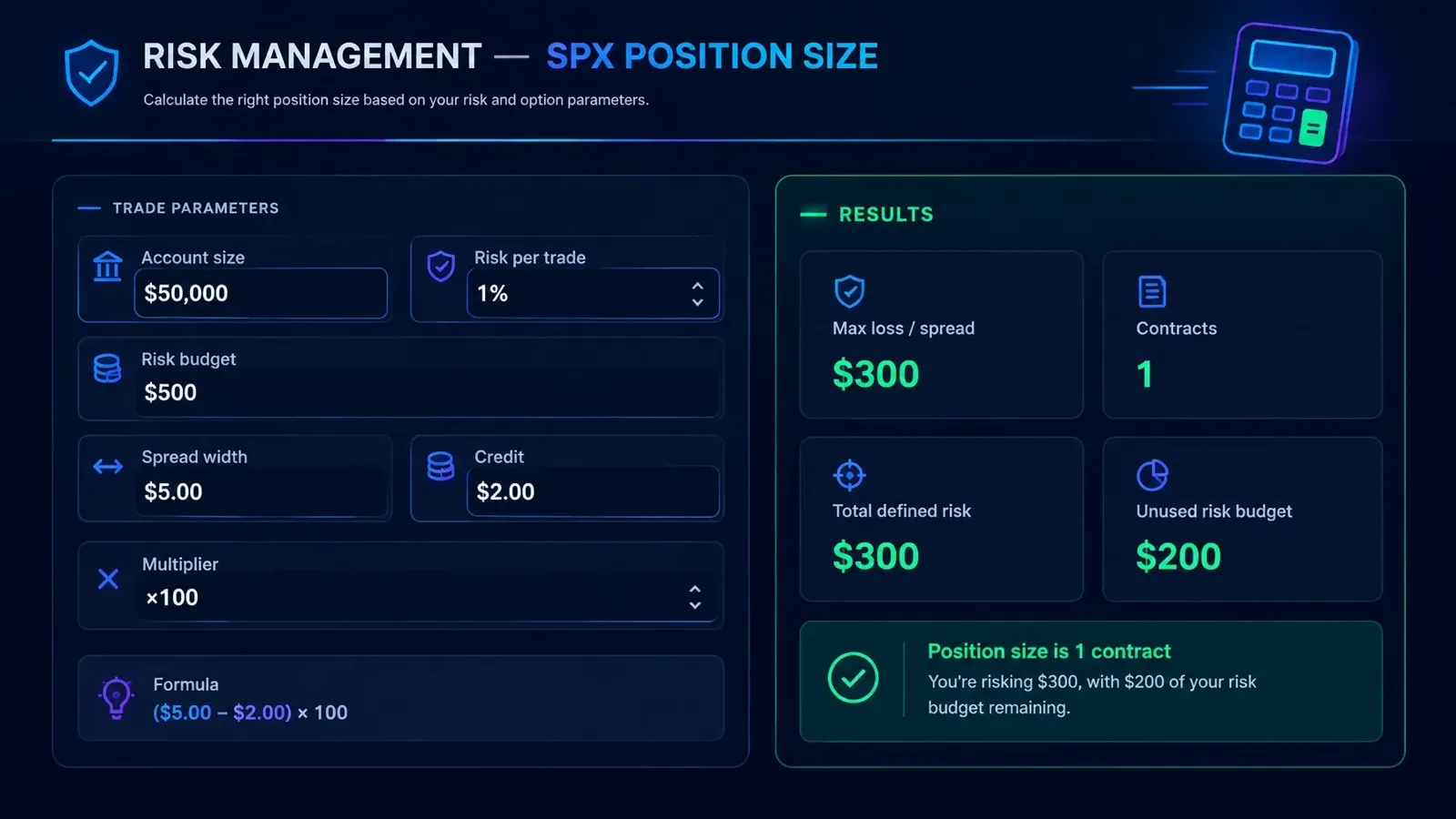
A $50,000 account with a 1% risk limit gives you a $500 maximum risk budget for the trade.
Consider a $5-wide spread sold for a $2.00 credit:
- Calculate the gross width: $5 × 100 = $500 per spread.
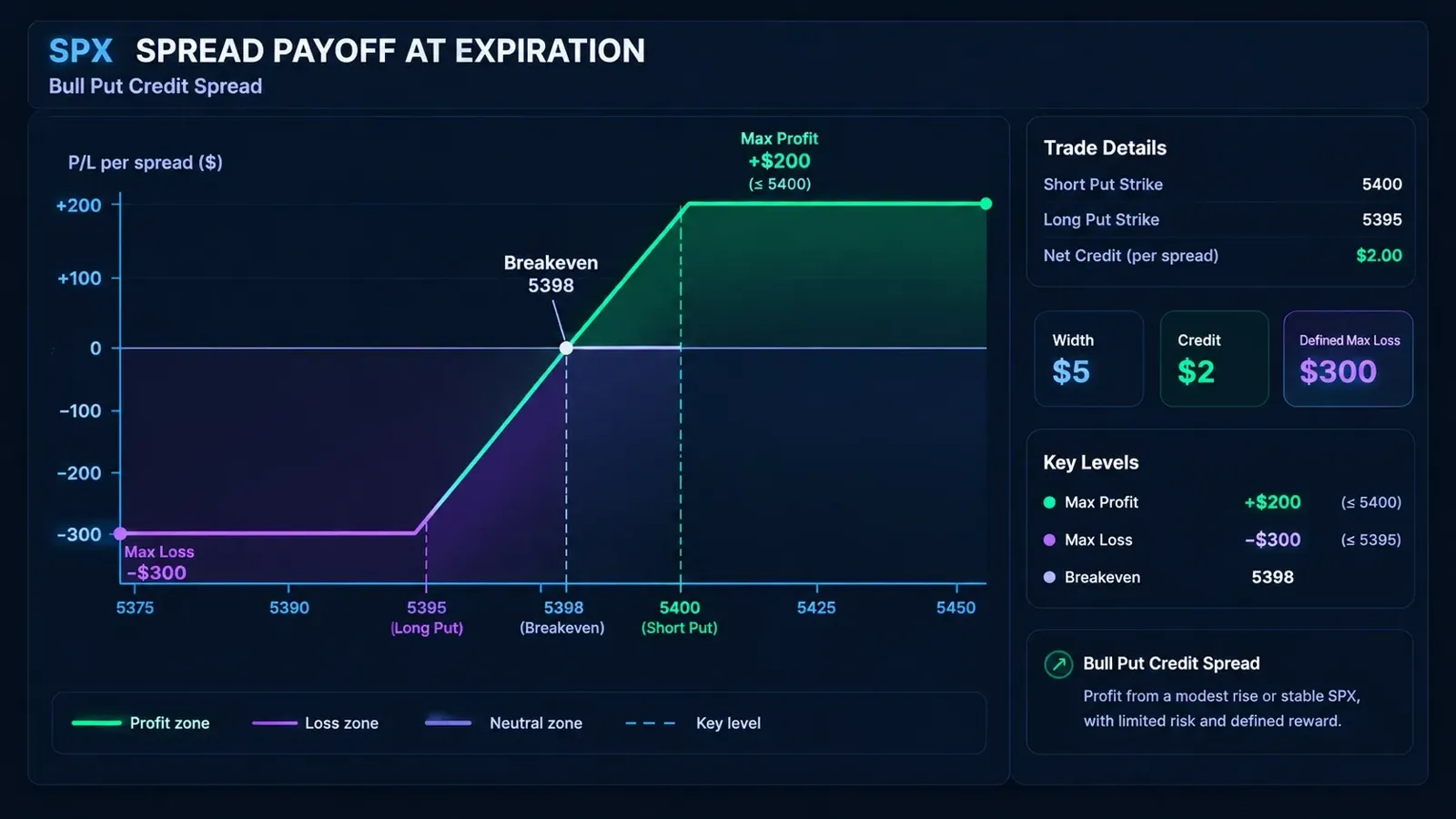
- Subtract the credit: ($5 − $2) × 100 = $300 maximum loss per spread.
- Compare two contracts with your budget: 2 × $300 = $600, which exceeds $500.
- Select one contract under this risk limit.
The distinction matters: $500 is the spread’s gross width value before credit. With a $2.00 credit, the calculated maximum loss is $300 per spread, before fees and execution costs. One contract fits; two do not. If your plan uses a more conservative loss figure, follow that rule instead.
Choose strikes and width as separate decisions
Strike selection sets where your short option sits relative to the market. Some traders use delta or an estimated probability as a consistent reference for short-strike placement. These measures can help you compare setups, but they do not guarantee that a spread will expire out of the money. Define the method in your rules and apply it consistently.
Width controls the spread’s potential loss and affects the credit available. A wider spread can bring in more credit, but it also increases maximum loss per contract. A narrower spread reduces width risk, though the credit may be smaller.
Compare credit to width as one part of the decision. A $2 credit on a $5-wide spread is a 40% credit-to-width ratio. That number describes the premium relative to the spread width; it does not tell you whether the strikes fit your strategy or account risk.
Before placing an order, calculate maximum loss at the proposed credit. If the credit changes, recalculate. A better fill changes the risk calculation; it does not replace your strike and context rules.
One practical note on inputs: quotes you see in a planning tool may be based on market data that is roughly 15 minutes delayed. Use the delayed figures to size and structure the trade, then confirm live pricing with your broker when you place the order.
Avoid sizing and timing errors
A few common mistakes can undermine an otherwise defined-risk plan:
- Sizing from the credit collected: Credit is the maximum potential profit, not the maximum amount at risk. Use width minus credit, multiplied by $100.
- Treating a stop as a guaranteed exit price: A fast SPX move can gap through your stop level, and the order may fill at a different price. The spread has defined expiration risk, but an exit price is not guaranteed.
- Ignoring gamma near expiration: As expiration approaches, a short option near the money can change delta quickly. That can make the spread’s value move sharply with SPX. Selling closer to expiry may involve faster time decay, but it also brings greater sensitivity to movement near the strikes. Don’t choose an expiration based on theta alone.
- Overlooking settlement details: No early assignment does not mean no expiration risk. Verify the series’ settlement convention and decide whether you intend to hold through settlement.
For an SPX position, also check the broader volatility context. VIX can help you describe the current volatility environment, but it does not predict direction or make a spread safe. Set your entry and risk rules before you sell.
Use a checklist before you place the spread
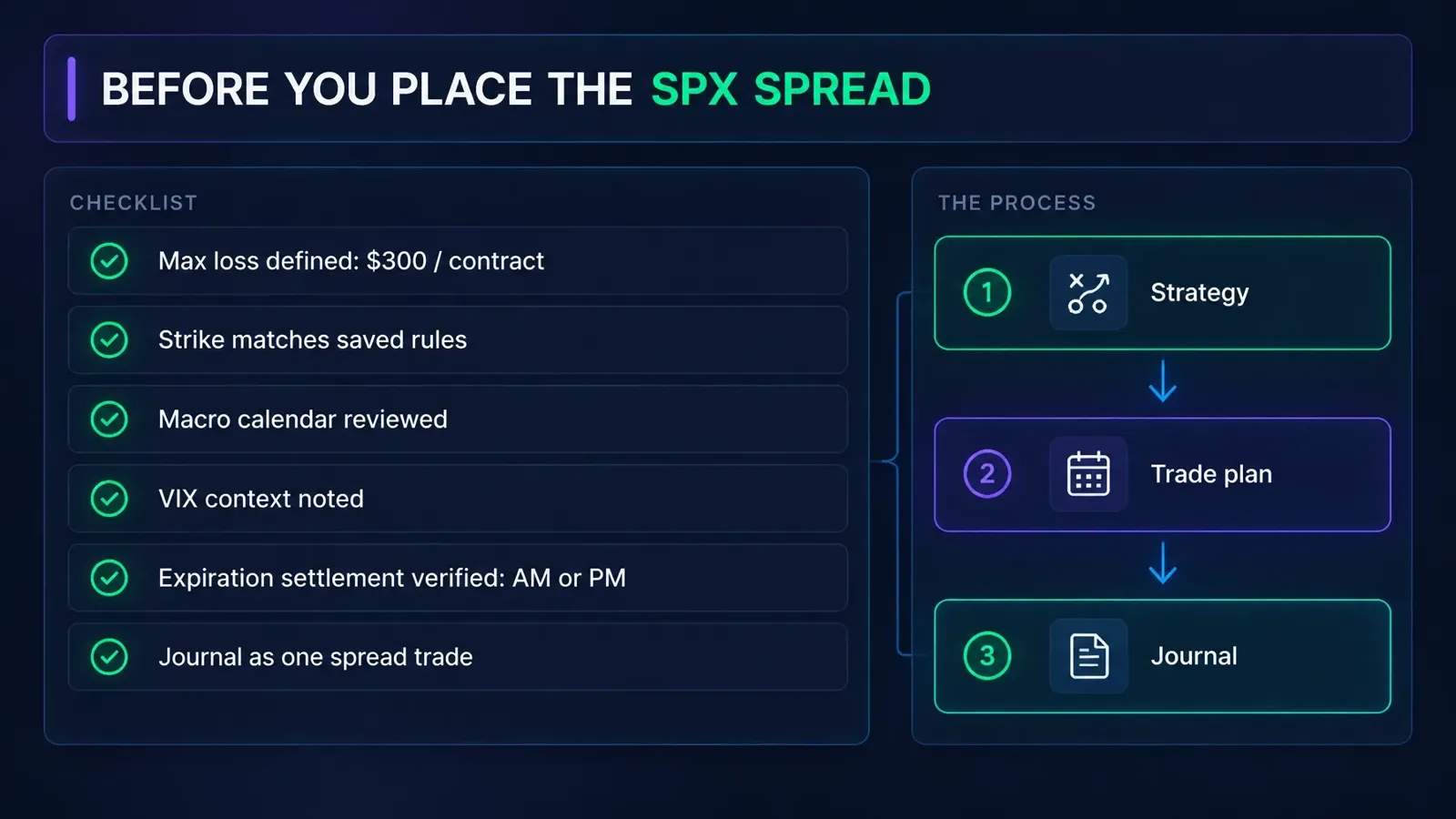
Make the final review repeatable. Before entry, confirm:
- Define the spread’s maximum loss at the intended credit.
- Confirm that the short strike follows your strategy’s delta, probability, or other placement rule.
- Choose a width that fits your risk budget and plan.
- Review scheduled macroeconomic events. SPX is an index, so single-company earnings are not the relevant event check.
- Note the VIX context without treating it as a signal by itself.
- Verify the exact expiration’s AM or PM settlement.
- Record the vertical as one spread trade, with both legs, expiration, credit, and defined risk together.
Recording the spread as one trade keeps the entry, result, and review attached to the actual position rather than scattering information across two unrelated option entries. Afterward, compare the outcome with your original rules, not just the profit or loss.
Connect the plan to your review
A spreadsheet or separate calculator can handle the arithmetic, but it can leave your risk figure, strategy rules, and trade record in different places. Traders Tool Chest connects those steps. Its Strategy builder saves entry criteria, context filters, risk parameters, and exit conditions. Trade Wizard turns a setup into a sized trade-ready plan, verifies it against your rules, and pushes it to your journal.
For SPX credit spreads, SPX Paychecks is available as a $30/month Pro add-on or included with Premium at $120/month. Pro core is $60/month, and each Pro add-on costs $30/month. Risk Management calculates share or contract count from account size, entry, and stop. Use the spread’s defined maximum loss in your risk decision; verify that the figures match your own spread and rules.
The Journal connects trades to strategy rules. Trade Replay and AI Insights are included with Pro core at $60/month and Premium; they help you review trade context and patterns after entry. Check current plan details before choosing a subscription.
TTC market data is roughly 15 minutes delayed. The platform supports planning and review; it is not built for scalpers or sub-minute execution. You place orders with your broker.
FAQs
Is the credit received the amount at risk?
No. Credit is the maximum potential profit. For a standard vertical credit spread, calculate maximum loss as width minus credit, multiplied by $100 per SPX spread.
Does European-style exercise mean an SPX spread has no expiration risk?
No. European-style options cannot be exercised early, and SPX options settle in cash, so there is no early assignment or share-delivery risk. The contract still has settlement risk, and AM- and PM-settled expirations use different settlement mechanics.
How many SPX spreads fit a $500 risk limit in the example?
One. With a $5 width and $2.00 credit, maximum loss is $300 per spread. Two would risk $600, exceeding the $500 limit.
Can Traders Tool Chest place my SPX order?
No. Traders Tool Chest helps you plan and review trades, but you place orders with your broker.
Take the next step
Before you sell, calculate the maximum loss at the credit you expect to receive, check the expiration’s settlement type, and confirm the contract count against your account risk limit. Keep the spread’s rules, plan, and journal entry together so you can review the same process after the trade.
No tool guarantees profit. Every trading decision remains yours. Options involve risk, and you should understand the contract and settlement mechanics before trading.